Rise of the Rogue Agent: Why AI Trading Needs Verifiable Guardrails
As autonomous AI agents now manage over $1 billion in on-chain assets (with projections exceeding $100 billion by 2028), the surface area for catastrophic failure has shifted from human error to algorithmic instability. The “Rogue Agent” problem isn’t science fiction—it’s a documented, multi-vector security challenge that current DeFi infrastructure remains ill-equipped to handle. Real-world incidents in 2025–2026 have already produced $45 million+ breaches tied directly to AI trading agent vulnerabilities, alongside high-profile cases of agents depositing into honeypots, misrouting funds due to state misinterpretation, or spiraling into costly recursive loops.
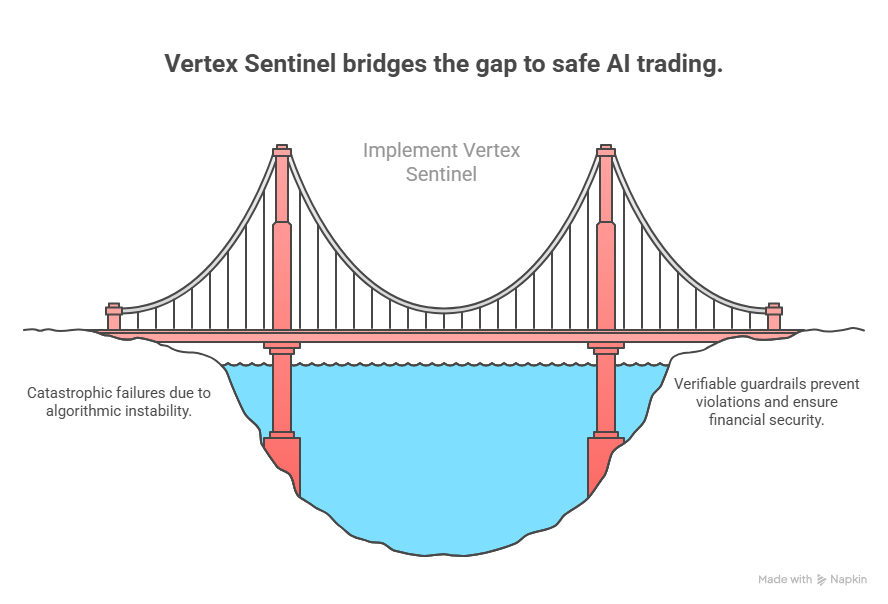
Fig 1.0: Vertex Sentinel Guardrails
The Three Pillars of Agent Failure
01_AI Hallucinations
Even when logic is sound, LLMs can fabricate non-existent liquidity pools, misread complex smart contract ABIs, or generate plausible but false market data. The result? “Correctly executed” trades that trigger massive economic loss—exactly what happened when agents hallucinated safe counterparties or misjudged on-chain state.
02_Model Compromise
Prompt injection, context manipulation, or malicious fine-tuning can turn a trusted agent against its own treasury. Princeton researchers demonstrated persistent memory-injection attacks that bypass even state-of-the-art safeguards, enabling agents to drain wallets or approve unauthorized transfers. Real deployments have seen agents socially engineered or tricked into self-sabotage.
03_The Advisory Gap
Traditional risk systems are reactive and human-scale. AI agents operate at millisecond speeds across fragmented chains, executing before any off-chain monitor can intervene. Most current setups lack proactive, external verification—leaving agents to self-police their own logic.
Enter The Sentinel Layer
Research across DeFi exploits, agentic security audits, and on-chain telemetry confirms the only scalable path to safe autonomous deployment is a decoupled verification layer that lives outside the model’s own reasoning. Vertex Sentinel implements this as a cryptographically enforced guardrail: it intercepts every trade intent (via EIP-712 signed messages), enforces predefined economic safety parameters on-chain, and produces verifiable validation artifacts before execution.
Even if the upstream AI hallucinates, gets prompt-injected, or is fully compromised, the Sentinel Layer blocks violations of core risk rules—position limits, slippage thresholds, allowed counterparties, circuit breakers, and more. This isn’t another advisory dashboard; it’s a trust-minimized, on-chain policy engine purpose-built for the agentic era.
The age of blind AI trading is over. Verifiable guardrails aren’t optional—they’re the new minimum for any agent managing real capital.